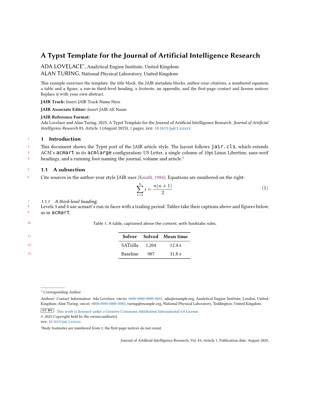
A Typst template for the Journal of Artificial Intelligence Research (JAIR).
JAIR ships a LaTeX-only author kit. This package reproduces that layout in Typst so you can draft and submit in Typst — JAIR accepts submissions as PDF — without hand-porting a LaTeX class.
It is called measured because every dimension in it was measured on PDFs
compiled with the real jair.cls, not copied from the class by eye. This is a
community port, not an official JAIR package.
typst init @preview/measured-jair:0.1.0
Provenance
The template follows jair.cls (2025/08/15), the class JAIR adopted for volume
83 onward. jair.cls loads acmart with [acmlarge, natbib=false, screen],
and acmart in turn loads amsart at 10pt — not article. That matters:
amsart’s size ladder differs from the familiar one at every step, so a template
built on article’s sizes is wrong everywhere.
Every value below was read out of the class files and then verified by
measuring compiled reference PDFs — the sample in the JAIR Author Kit and a
second document compiled with jair.cls on an unfilled page, so that TeX’s
stretchable glue sits at its natural size. Positions were taken from the
glyph outlines of a 600 dpi render, so they do not depend on font metrics.
Type
| Element | LaTeX | amsart 10pt | Reference | Template |
|---|---|---|---|---|
| Body | \normalsize |
10 / 12 | 9.96, b2b 11.95 | 9.96, b2b 11.95 |
| Abstract | \small |
9 / 11 | 8.97 | 8.97 |
| Sections and subsections | \large |
10.95 / 13 | 10.91 | 10.91 |
| Author names | \Large |
12 / 14 | 11.96 | 11.96 |
| Title | \LARGE |
14.4 / 17 | 14.35 | 14.35 |
| Head, foot, footnotes | \footnotesize |
8 / 10 | 7.97 | 7.97 |
Line numbers (review) |
\scriptsize |
7 / 8 | 6.97 | 6.97 |
jair.cls overrides both \@secfont and \@subsecfont, so sections and
subsections share one size — unlike stock acmart. Levels 3 and 4 use the
class’s run-in faces (sans italic and serif italic, each with a trailing
period); see Known deviations for how far the run-in behavior is reproduced.
Layout
acmart’s dimensions are TeX points (1/72.27 in); Typst’s pt is the big point
(1/72 in), so every copied value is scaled by 72/72.27. includeheadfoot means
the 78pt/114pt margins bound header + text + foot, not the text alone: the 13pt
head and 14pt headsep come out of the top margin.
| Element | Reference | Template |
|---|---|---|
| Page | 612 × 792, two-sided, one column | ✓ |
| Text left edge | 80.7 | 80.7 |
| Running head | 79.70 | 79.70 |
| First body line | 106.93 | 106.86 |
| Title | 103.57 | 103.44 |
| Running foot | 670.35 | 670.37 |
Line numbers (review) |
x 54.6, pure red, none on p.1 | x 54.6, pure red, none on the p.1 title block |
| Running-head separator | 7.97 each side of the bullet | 7.97 |
| First-page footnote block | flush at the text edge | flush |
Vertical spacing
Typst has no stretchable glue and gives text lines a fixed 1em box, so the
class values cannot be copied directly. Each transition below was fitted so
that the ink-to-ink distance matches a jair.cls document on an unfilled page.
| Transition | Class value | Reference | Template |
|---|---|---|---|
| Text → display equation | 0.35\baselineskip plus stretch |
6.1–6.7 | 6.2 |
| Display equation → text | same | 6.1–6.8 | 6.7 |
| Text → figure | \intextsep 12pt |
12.1 | 12.1 |
| Figure → caption | \abovecaptionskip 10pt |
13.3 | 13.4 |
| Figure caption → text | 15.8 | 16.1 | |
| Table caption → top rule | 13.2 | 12.7 | |
| Table rule → row → rule | booktabs | 4.7 / 5.3 / 4.9 / 5.4 | 4.1 / 5.9 / 4.7 / 5.6 |
| Subsection → level-3 heading | -.5\baselineskip |
7.8 | 7.8 |
| Text → level-4 heading | -.5\baselineskip |
8.5 | 8.5 |
| Text → list | \topsep = \smallskipamount |
4.8 | 4.9 |
| Last author → abstract | 9.2 | 9.5 | |
| Abstract and JAIR blocks | \medskip |
7.1 / 7.2 | 6.8 / 7.2 |
| JAIR reference format → first heading | \bigskip merged with the section skip |
12.4 | 12.4 |
The baseline grid is pinned with top-edge/bottom-edge rather than left to
font metrics, so spacing holds at amsart’s values whichever font resolves —
checked to give the same grid with Linux Libertine and Libertinus Serif. That
matters on the Typst web app, where the font set differs.
Usage
#import "@preview/measured-jair:0.1.0": jair, toprule, midrule, botrule

#show: jair.with(
  title: "Your Article Title",
  short-title: "Short Title",              // running head
  authors: (
    (
      name: "Ada Lovelace",
      affiliation: "Analytical Engine Institute, United Kingdom",
      contact-affiliation: "Analytical Engine Institute, London, United Kingdom",
      email: "ada@example.org",
      orcid: "0000-0000-0000-0000",
      corresponding: true,
    ),
  ),
  short-authors: "Lovelace",               // running head
  abstract: [Your abstract. JAIR prints it with no "Abstract" heading.],
  track: "Insert JAIR Track Name Here",    // omit unless in a special track
  associate-editor: "Insert JAIR AE Name",
  volume: "83", article: "1",
  pubdate: "August 2025", year: "2025",
  doi: "10.1613/jair.1.xxxxx",
  review: true,                            // line numbers, as the JAIR example does
  received: "Received 20 February 2007; accepted 5 June 2009",
  acknowledgements: [Thanks to ...],
  bibliography: bibliography("refs.bib", title: [References],
                             style: "american-psychological-association"),
  appendix: [ = Supplementary material ],
)

= Introduction
...

#figure(
  table(columns: 2, toprule, table.header[*A*][*B*], midrule, [1], [2], botrule),
  caption: [Tables are captioned above.],
)
Parameters
| Parameter | Default | Purpose |
|---|---|---|
title |
required | Article title; used in the running head and the JAIR reference format. |
short-title |
title |
Running-head form of the title. Give one whenever the title is longer than a line; the running head does not truncate. |
authors |
() |
Array of dictionaries. name (a string) is required; affiliation, email, orcid, corresponding and contact-affiliation (the longer form printed in the contact footnote) are optional. |
short-authors |
derived | Running-head author list. acmart’s default is the full names — “A”, “A and B”, “A, B, and C” — and that is what the template derives; the JAIR sample overrides it with surnames, so pass e.g. "Xu, Hutter, Hoos & Leyton-Brown" for that look. |
abstract |
none |
Printed in \small with no heading. |
track |
none |
JAIR Track line; printed only when given. |
associate-editor |
"Insert JAIR AE Name" |
JAIR Associate Editor line. Printed unconditionally, as jair.cls does; replace the placeholder. |
volume, article |
"1", "1" |
Running head/foot and the reference format. Placeholders until the journal assigns them. |
pubdate, year |
none |
Publication month and year for the foot, the reference format and the copyright line. Each is omitted from the output while none. |
doi |
none |
Printed in the reference format and the license notice when given. |
received |
none |
Printed in \small at the end, e.g. “Received … ; accepted …”. |
acknowledgements |
none |
Unnumbered section before the references. |
appendix |
none |
Set after the references, headings lettered. |
copyright-holder |
none |
Replaces “Copyright held by the owner/author(s).” with “holder.” |
review |
false |
Line numbers restarting on every page, like \documentclass[review]{jair}. |
anonymous |
false |
One “ANONYMOUS AUTHOR(S)” line, no contact footnote, “Anonymous” in the running head. JAIR does not use blind review; for preprints or other venues. |
bibliography |
none |
Pass a bibliography(...) call. |
keywords, ccs |
(), none |
Exist because acmart supports them. See the next section. |
Headings: levels 1–3 are numbered (1, 1.1, 1.1.1), level 4 and below
are not, matching secnumdepth 3. Levels 5 and 6 fall back to the level-4
face.
toprule, midrule and botrule are the booktabs rules acmart loads:
0.08em heavy for the top and bottom, 0.05em light in between.
CCS concepts and keywords
JAIR’s own kit says: “Do not include ACM CCS Concepts or Keywords.” The
ccs and keywords parameters exist because acmart supports them, and are
left unset in the shipped example. Do not use them for a JAIR submission.
Citation style
JAIR uses author–year citations (acmauthoryear in the LaTeX kit). Typst has
no bundled ACM author–year CSL, so the example uses
american-psychological-association, which is close but not identical. For an
exact match, put an ACM author–year CSL file beside your document and pass it
as style: "acm-author-year.csl".
Fonts
acmart sets JAIR in Linux Libertine, with Linux Biolinum for sans-serif and Inconsolata for monospace; math is a Libertine-matched face. The template asks for those first, then for Libertinus, then for TeX Gyre Heros as the sans of last resort.
Typst’s compiler embeds Libertinus Serif, New Computer Modern with its math face and DejaVu Sans Mono, but no sans-serif family. Without one, the title, byline, headings, running heads and captions silently fall back to the serif. On a TeX Live machine Linux Biolinum O is present. In the Typst web app check the font list of your project; if no Biolinum, Libertinus Sans or TeX Gyre Heros is offered, upload the Linux Biolinum O files (they are free) to the project.
Typst warns once per use about each family it cannot find; the warnings are harmless as long as one family per list resolves.
Known deviations
Stated plainly, because this is a reimplementation and not the class itself:
- Not byte-identical. TeX and Typst break lines and hyphenate differently, so text will not fall identically even where every dimension matches.
- No glue. acmlarge pages are flush-bottom and stretch the space around displays, floats and headings to fill each page; Typst pages are ragged-bottom and use the fitted natural values above.
- Run-in headings. acmart makes levels 3 and 4 run-in: the heading sits on the same line as the paragraph that follows it. Typst always starts a new paragraph after a heading, so the face, the trailing period and the space above are matched but the text begins on the next line.
- Consecutive lists. LaTeX puts two
\topseps between a list that directly follows another; Typst collapses them to one, so that gap is about 2pt tighter than in the class. - Footnote rules. acmart draws a full-width rule above the first-page contact/copyright block and a 4pc rule above ordinary footnotes. Typst has one footnote separator per document, so the 4pc rule is used throughout.
- CC BY badge is drawn as a boxed “CC BY” rather than the official 88×31 image, to keep the package free of binary assets.
- Line numbers. acmart’s
reviewoption draws a fixed ruler in the margin, numbering 12pt slots regardless of where text actually falls; Typst numbers real lines. Color (pure red), size, left alignment, margin position and restart on every page match; the numbers correspond to lines rather than slots. acmart shows no ruler on page 1; here the title block carries no numbers but body lines that start on page 1 do. Hiding them would need a per-linecontextlookup of the page counter, which keeps documents of a few dozen pages from converging. - Author grouping. acmart can put several authors sharing an affiliation on
one byline row; here every author gets a line of their own, which is what jair.cls’s
\@mkauthors@idoes for the journal formats anyway. - Theorem environments are not styled to acmart’s
acmplain/acmdefinition. - Teaser figures, subtitles and
\titlenote/\authornoteare not implemented; the only note mechanism is the corresponding-author asterisk.
Before you submit
- JAIR accepts PDF only at submission; the LaTeX class is used to produce the published version. Confirm with the editors if you intend to stay in Typst through acceptance.
- Fill in the JAIR associate editor and replace the placeholder DOI.
- JAIR asks authors to be concise but sets no page limit.
License
MIT for the package (lib.typ and the documentation); MIT-0 for everything
under template/, so a document started from the template carries no
attribution obligation. Both texts are in LICENSE. The layout parameters are
derived from jair.cls and acmart.cls, both distributed under the LaTeX
Project Public License; no code from either is included.
