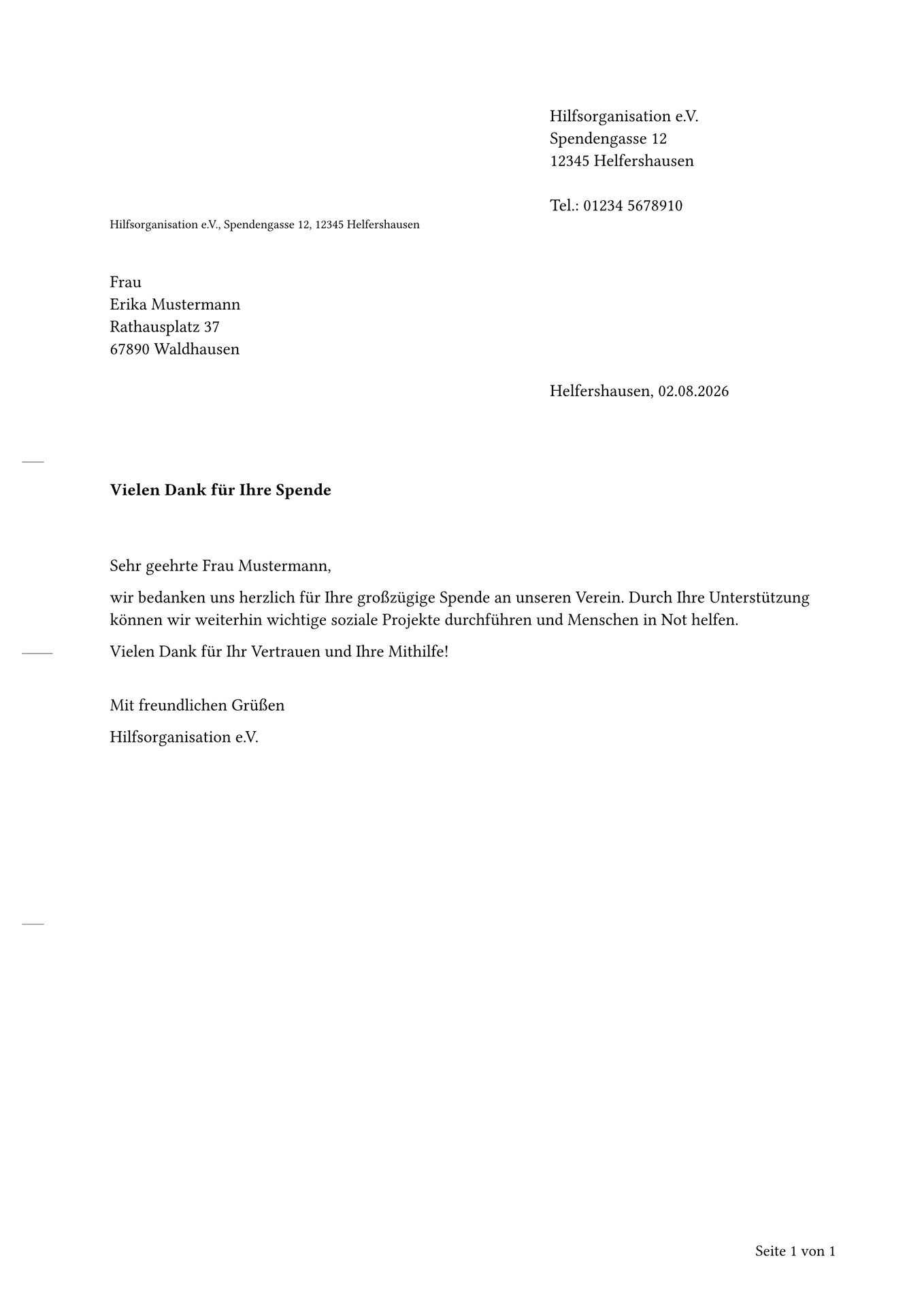
Briefs is a simple Typst template for letters (German: Briefe). It is inspired by DIN 5008 and targets A4 paper. The address box aligns with the window of a DIN lang envelope.
Example
#import "@preview/briefs:0.4.0": letter

#set text(lang: "de", font: "TeX Gyre Heros")
#show: letter.with(
  sender: (
    [Hilfsorganisation e.V.],
    [Spendengasse 12],
    [12345 Helfershausen]
  ),
  recipient: [
    Frau\
    Erika Mustermann\
    Rathausplatz 37\
    67890 Waldhausen
  ],
  information-extra: [
    \
    Tel.: 01234 5678910
  ],
  location: "Helfershausen",
  subject: [*Vielen Dank für Ihre Spende*]
)

Sehr geehrte Frau Mustermann,

wir bedanken uns herzlich für Ihre großzügige Spende an unseren Verein.
Durch Ihre Unterstützung können wir weiterhin wichtige soziale Projekte
durchführen und Menschen in Not helfen.

Vielen Dank für Ihr Vertrauen und Ihre Mithilfe!

#v(0.5cm)
Mit freundlichen Grüßen

Hilfsorganisation e.V.

Additional examples can be found in the
tests directory.
Reference
Document Structure
The image below shows the basic document structure. The address box contains
sender and recipient.
The information box contains supplementary information.
By default, it displays the sender, content in information-extra,
location, and date.

API
letter(
  sender: (),
  sender-font-size: 8pt,
  sender-separator: [, ],
  recipient: [],
  recipient-top-margin: 12.7mm,
  address-box: (25mm, 50mm, 80mm, 40mm),
  information: auto,
  information-box: (125mm, 25mm, 75mm, 65mm),
  information-extra: none,
  date: auto,
  date-format: auto,
  location: none,
  location-date-separator: [, ],
  subject: none,
  folding-marks: (:),
  hole-punch-marks: (:),
  background: [],
  show-boxes: false,
  numbering-first-page: "always",
  ..page-args,
  body
)
Arguments
sender array of content Default: ()
The sender’s address. This address is shown in the address box
with font size sender-font-size and concatenated with separator
sender-separator. If information is auto, this address is also
shown at the top of the information box.
sender-font-size length Default: 8pt
The font size for the sender’s address in the address box
sender-separator content Default: [, ]
The separator between the sender’s address parts in the address box
recipient content Default: []
The recipient’s address. Line breaks must be inserted manually.
recipient-top-margin length Default: 12.7mm
The recipient’s top margin in the address box
address-box array of length Default: (25mm, 50mm, 80mm, 40mm)
Absolute position and size of the address box in the form
(x, y, width, height).
information auto | content Default: auto
The content of the information box. If this is auto, the sender,
optional content in information-extra, the location, and the date
are shown as a default.
information-box array of length Default: (125mm, 25mm, 75mm, 65mm)
Absolute position and size of the information box in the form
(x, y, width, height).
information-extra none | content Default: none
Additional content for the information box (only used if information
is auto). This content is displayed after the sender and can be used,
for example, to show a phone number or email address.
date none | auto | datetime | content Default: auto
The date (only used if information is auto). If this is
auto, the current date is shown. If auto or a value of type datetime
is provided, the date will be formatted with date-format.
date-format auto | str Default: auto
The date format pattern which is applied if date is auto or of type
datetime. If date-format is a string, it is passed directly to Typst’s
datetime.display() function. If date-format is auto, the pattern
passed to datetime.display() is determined as follows:
- if
text.lang = "de":"[day].[month].[year]" - if
text.lang = "en":"[month repr:long] [day padding:none], [year]" - otherwise:
auto
location none | content Default: none
The location (only used if information is auto)
location-date-separator content Default: [, ]
The separator between location and date
subject none | content Default: none
The subject
folding-marks none | dictionary Default: (:)
Whether folding marks are displayed and how they are rendered.
If none, no marks are shown.
Otherwise, a dictionary defines how the marks are shown. The dictionary
can have the following keys:
pagesstr
On which pages the marks are shown:"both","even", or"odd"lengthlength
The length of the marksstrokestroke
The stroke of the marksxdistlength
The distance to the left edge of the page
All keys are optional. If provided, they overwrite their default value.
The default is (pages: "both", length: 5mm, stroke: 0.25pt, xdist: 5mm).
hole-punch-marks none | dictionary Default: (:)
Whether hole punch marks are displayed and how they are rendered.
See folding-marks for details.
The default is (pages: "both", length: 7mm, stroke: 0.25pt, xdist: 5mm).
background content Default: []
Content for the page background. The folding marks and the hole punch
marks are placed on the page’s background. If you want to add additional
content to the background, provide it here.
show-boxes bool Default: false
Whether address box and information box are framed.
This is primarily intended for layout debugging.
numbering-first-page str Default: "always"
Whether a page number is displayed on the first page:
"always": Always, even for single-page letters"multiple": If the letter has multiple pages"never": Never, even for multi-page letters
This argument is used in the default numbering
(see numbering in page-args below). If you overwrite
numbering, numbering-first-page has no effect.
page-args any (variadic)
Additional arguments for Typst’s page() function.
Default arguments (can be overwritten):
margin: (left: 25mm, rest: 20mm),
number-align: bottom + right,
numbering: (i, t) => if (numbering-first-page == "always") or
  (numbering-first-page == "multiple" and t > 1) or
  (numbering-first-page == "never" and i > 1) {
    text(10pt, context (localized().page-number)(i, t))
  },
body content
The letter content